Matheus Knebel

Gym Re-design
Hi again!
Here I'll present some perceptions of game’s information issues which are based on personal use, Reddit and YouTube digging and into the problem to solve proposed in the exercise. Although some problems can be later shown as less significant than they appear to be, and others can show more significance to new user’s experience than appears. In the later part of this exercise I propose some metrics that could help to evaluate the issues addressed or even bring up new insights.
CHALLENGES
Get new players to understand Gym’s significance
Gyms are for now the only investment of the game into the social direction once there one can play with friends or meet other players. There players can collaborate with team mates to compete against other teams and conquest territory. The problem relies on the uninviting experience for new players of playing against way stronger pokémons, that can result on players not being able to experience the social possibilities of the game once the only other function of the Gym would be to turn the discs for items.
Prepare to a successful battle against stronger pokémons
Performing research, one can find that the best chance to beat a pokémon stronger than his/hers is through strategic Type selection (watch a player beating pokémons with almost twice theirs’ CP). Still, Pokémon Go provide no instructions about Type advantages/disadvantages. In this publication IGN shows a chart comparing the attack effectiveness among each type, but once there are 18 types, there are 324 possibilities which would require a huge memory load from users to know right away that, for instance, his/hers Psychic type would be super effective against the Poison type opponent, but not very effective against the Dragon type one.
Learn moves and attacks
Players are currently dropped into the battles and have to learn that the attack, super attack and dodging functionalities. There is a readable manual at each Gym, but when information is given out of use context, learning it demands memory load. Information learned this way (when read at all) get forgotten faster. Still, in-game tutorials can be intrusive and break the game flow when are too obvious for some players who learn naturally. All these variables must be taken into account in order to deliver effective learning.
OPPORTUNITIES
The Gym’s system can already provide good experiences for experienced players. Significant visibility issues that were happening in the earlier versions of the Gym have been solved, like the “GO” button that was changed for a better positioned/visible “Go Battle!” one, and the super attack that had to be discovered now shows a button when is available.
My hypothesis is that these changes are not enough, but with not-very-big changes new players can be also embraced into the Gym’s everyday experiences.
My proposition is a Gym’s dynamic training functionality: once per day the player can train at each adversary’s Gyms. That would be a dynamic-guided train, meaning let players try first, and if she/he is not doing dodging, for instance, then some non-intrusive tip remembers to do so. In this proposition the train would happen against 3 NPC’s Pokémons chosen automatically taking into consideration player’s Pokémons CPs and Types.
For instance, if player is in Training mode and has among his/hers best pokémons a 100CP water, a 300CP fire and a 400CP electric pokémon, NPC adversaries could be presented like a 100CP fire, a 400CP grass and an 800CP water pokémon (that are respectively ineffective against player’s available ones).
Player is free to choose any of his pokémons, but the system must provide a type comparison functionality.
The comparison functionality works showing the effectiveness of player’s pokémons against opponent’s ones (I’m going to show in the prototype how it can work in a simple way).
Winning the training battles player is rewarded with some items (probably a couple potions are appropriated) and XP. The player will still have to get better Pokémons in order to win Gym’s real battles (so that the experienced player’s experience is not compromised), but as it may take a while, the reward is used here to engage the constant interaction with Gym’s battles.
The following chart organizes the features to teach in learning contexts trying to solve the information’ lack noticed.

PROTOTYPE
Clicking on the screen image bellow you will be directed to the prototype's page. If you want to interact with it through your mobile just let me know and I'll send the directions.
I started with a wireframe that resulted from the organization above and the final prototype was build with Sketch App + Atomic.
Due tool's limitations the tutorial is linear. You can open/close menus and scroll the selection modal at will, but the pokémons are only selectable in the following order. In doubt, please move your mouse until it hovers a clickable pokémon.


If for any reason the prototype didn't work properly you can watch it being used here.
The best way I've found to help players to prepare for successful battles is by letting visible the Type advantages (VERY EFFECTIVE/NOT VERY EFFECTIVE) so she/he can easily compare.
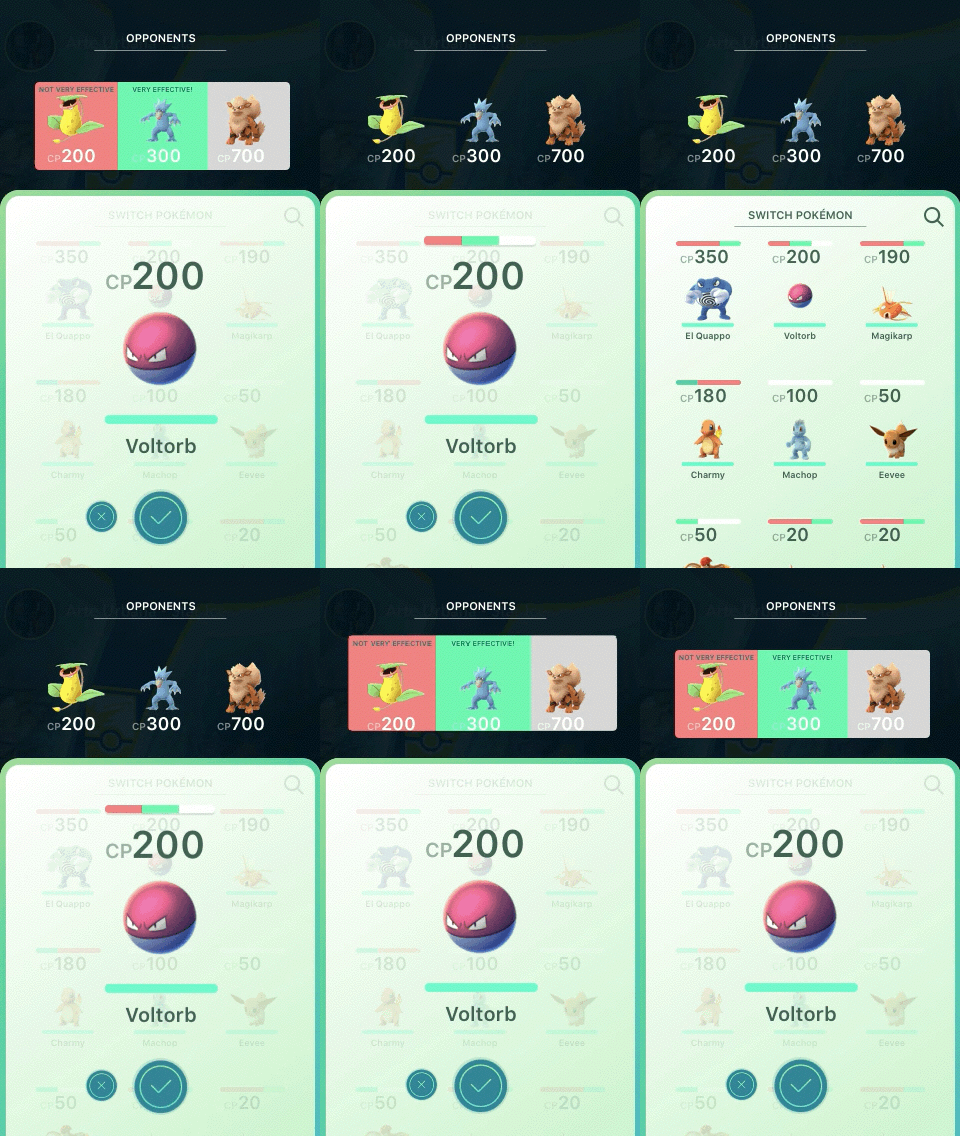

One additional feature not seen in the prototype is the possibility to easily drag and drop switching the order of the Pokémons in a strategical way.
EVALUATION
In order to evaluate the hypothesis and proposition the following questionnaire may be appropriate. It can be applied with new Pokémon Go players in this sequence:
-
Player plays a current Gym’s battle
-
Responds questionnaire
-
Plays a Gym’s training prototype
-
Responds again the questionnaire
Before and after delivering the Training system, analytics can be implemented into the game in order to validate questionnaire insights collecting metrics (M) of usage effectiveness with the following variables:
(M1) During active days with travel, on average, how many times players battle in Gym?
(M2) During team choosing step, what is the % of pokémon switched?
(M3) During battle, when super attack is charged, what is the % of super attack use?
(M4) During battle, in comparison to attack, what is the % of dodging?
Once the proposed challenge is to get new players to learn, understand and, as result, engage into Gym’s, the metrics could be applied to players from level 5 to 10. Comparing the before and after results, if the all the metrics get increased, the engaging factor can be as well considered of relative increased success. If the amount of Gym’s use is increased, potentially the understanding of Gym’s significance tends to increase too (and here must be clear that only potentially, once it’s a tricky abstract factor to measure).
How these metrics works?
M1 - This includes training battles once is the proposed way to invite new players. It also makes sense to exclude days (that for unknown reasons) players didn’t went out to travel through streets to be able to reach a Gym.
M2 - Considering the opponents on different Gym have diverse types, if player is understanding the advantages of choosing strategically between hers/his types, the number of switches between pokémons (including their order in the set) tends to increase.
M3 – If players have a super attack available usually makes sense to use it once delivers far more damage (even considering if it’s of an ineffective type which would deal relatively less damage). There are more factors to consider that can influence player’s decision, like the lower speed taken to deal a super attack, but in sum, if player is not using super attacks at all they probably wouldn’t be understanding yet it’s possibility.
M4 – This must be a relative factor (comparing with the amount of attacks) once less attacks can mean that his/hers pokémons won or loose the battle earlier and had equivalent less time to use the dodging movements.
IMPLEMENTATION
By giving focus to what I believe to be the root of the issues with new players, I found a relatively simple way to improve the experience, with small or no changes in the rest of the game system. The more demanding feature presented would be the system that select NPC opponents taking into consideration (something like) the eight strongest Pokémon's the player has available. After looking at player's eight strongest pokémons three NPCs would have to be selected with proportional CP as exemplified earlier.
Another demanding point would be the NPC that comes in the last (and hardest) of the three battles to help the player (for the sense of teaching the player that he/she can bring friends to help in the Gym's battles). But still, the AI needed to do so already exists in every Raid boss, then I still believe this implementation wouldn't demand many "new things" as well.
CONCLUSIONS
The propositions and metrics here presented were made by myself within a small period of time. They are prototypes themselves! For sure after showing this to a team of designers, developers and producers with different backgrounds (preferably with more in-depth knowledge of Pokémon GO’s users and inner mechanics) some answers could arise, some propositions could have better alternatives, and some could be invalidated right away.
Other topics could be added here, like a way to put these tests into Agile sprints of discovering, crafting and validations. There is a nutshell-like post I made about Agile in game development on my blog, feel invited to scroll a bit more there!
I focused here on trying to solve the problem proposed by the exercise given, which mainly relies on the difficulty of new players. I didn’t invest much effort on changing most of the surface level of the Gym (it's visuals) once in this case my hypothesis is that the main problem starts in preparing players for successful battles that, as result, would be more inviting for them to interact with Gym more often. The visuals of UI and their organization have been updated as said earlier, and sounds to be clear after watching YouTube’s gamers trying it even for the very first time. Still, in order to validate the clearness of UI’s important components like the “quit” and “bag” buttons, or the special attack button on the GUI, a questionnaire asking things like “being at the Gym, it is clear how to get out of there?” and “being at the Gym, how would you restore your pokémon’s HP?”.
LAST NOTE
Sorry for the long text, after this we are done, I promise :D
I wasn't playing Pokémon Go since 2016 and started again in order to make this evaluation. I really enjoyed the real world explorations (which I made by bike around the town) provided through the game and there are so many positive aspects that may seem occluded in this critical UI/UX evaluation. But even when we are in love with our game I believe it's important to adopt a critical approach in order to perceive the hidden improvements that can bring value for users, which by result will convert into value for the company! This evaluation was made in a short period of time based on consistent published heuristics. For sure with a bit more of time, data resources and mainly interaction with players more insights could be delivered, but I hope to have achieved satisfactory results for now!
Please, let me know of any doubt!
Cheers,